
Aesthetic Unicode Fonts: Symbols & Stylized Text Generator
Generate aesthetic Unicode fonts, full-width vaporwave letters, circled bubble text, small caps, and decorative symbol frames for social profiles and bios.
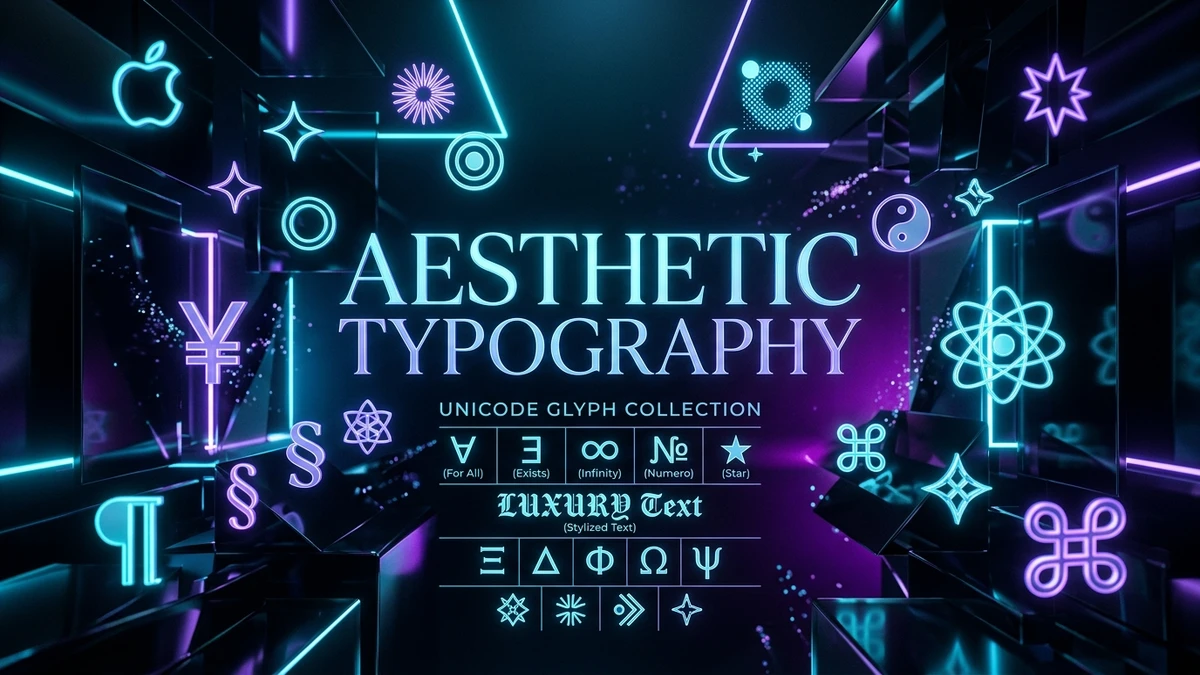
Unicode Architecture
Vaporwave and aesthetic typography relies on Unicode Halfwidth and Fullwidth Forms (U+FF01 to U+FF5E) alongside Supplementary Multilingual Plane 1 mathematical codepoints.
What Are Aesthetic Unicode Fonts and How Do Social Platforms Render Them?
Aesthetic Unicode Fonts transforms standard Latin letters into vaporwave wide lettering, circled bubbles, small capitals, and decorative frames for Instagram bios and creator profiles.
Modern social media profiles on platforms such as Instagram, TikTok, Discord, and Pinterest rely on distinctive visual presentation to capture visitor attention within the critical first three seconds. Because social platforms intentionally restrict custom CSS styles, creators utilize specialized Unicode subsets to achieve customized aesthetic text.
Full-width vaporwave text, for instance, originates from the Halfwidth and Fullwidth Forms block (U+FF00 to U+FFEF), historically developed to ensure Latin characters matched the fixed square bounding boxes of East Asian CJK typography. When used in digital bios, these wider glyphs create an airy, architectural cadence that stands out sharply against standard mobile font stacks.
Similarly, small capitals leverage phonetic characters codified in Unicode's linguistic research blocks. Because these glyphs feature optical proportioning designed by typographers rather than algorithmic scaling, they maintain balanced stroke weight and crisp legibility even on compact mobile screens.
Engineering Principles Behind Fullwidth Character Mapping
Standard ASCII characters occupy codepoints 0x21 through 0x7E. When an author types standard alphanumeric text, the browser allocates a single 7-bit ASCII representation. To generate authentic vaporwave text, our conversion engine applies a deterministic mathematical mapping: each character code between 33 and 126 is offset by exactly 65,248 (0xFEE0), placing the resulting glyph squarely into the Fullwidth Forms block. For example, standard exclamation mark (U+0021) shifts to fullwidth exclamation mark (U+FF01), and standard letter A (U+0041) shifts to fullwidth letter A (U+FF21). The single exception is the space character (U+0020), which shifts to the ideographic space (U+3000) to preserve proportionate typographical pauses.
This mathematical precision ensures that copy generated on our platform never suffers from rendering anomalies, missing question mark boxes (tofu symbols), or unexpected line break collapses when pasted into iOS or Android applications.
Bio Architecture & Typographical Curation Guidelines
While stylized typography provides undeniable visual flair, disciplined application separates amateur profiles from authoritative brands. Leading creators apply aesthetic fonts using a structured three-tier visual hierarchy:
Reserved strictly for the primary username or the opening headline (under 30 characters). Commands immediate optical focus in crowded discovery feeds.
Applied to core credentials, project categories, or bullet headers. Delivers distinct typographic texture without compromising reading velocity.
Essential URLs, contact details, and core descriptions remain in standard plain text to preserve 100% screen reader accessibility and link parser reliability.
Aesthetic Typography Evolution & Assistive Technology Standards
From Early Japanese Computing to Vaporwave Aesthetics
The visual language of modern aesthetic fonts possesses a fascinating technical lineage rooted in early computer science and multilingual typesetting. During the early days of personal computing in Japan, legacy systems like the NEC PC-9801 and early JIS standards required two distinct character widths: single-byte half-width characters (matching standard Western ASCII spacing) and double-byte full-width characters designed to align seamlessly with square Kanji ideographs.
When the Unicode Consortium unified international character encodings, these wide letterforms were preserved in the Halfwidth and Fullwidth Forms block (U+FF01 through U+FF5E) to guarantee backward compatibility with legacy Asian databases. Decades later, internet subcultures, electronic musicians, and digital creators rediscovered these wide characters, adopting them as the defining visual hallmark of the vaporwave movement. The deliberate, wide-set kerning evoked a sense of nostalgic computing, retro-futurism, and digital irony.
Today, aesthetic text extends far beyond vaporwave. The Enclosed Alphanumerics block (U+2460 through U+24FF) and Negative Circled Alphanumerics (U+1F150 through U+1F169)—originally designed for patent diagrams, mathematical proofs, and schematic numbering—have become indispensable tools for modern social media influencers who want to create clean numbered lists, bullet points, and high-contrast avatar badges that command attention in discovery feeds.
Screen Reader Accessibility & Assistive Technology Standards
Accessibility Best Practices and Screen Reader Compatibility
While stylized Unicode typography offers striking visual differentiation, responsible content creators must understand how assistive technologies process these characters. Screen readers utilized by visually impaired or blind internet users (including Apple VoiceOver, NVDA, and JAWS) read standard Latin text phonetically based on standard dictionary pronunciation. However, when a screen reader encounters characters from specialized Unicode blocks, it articulates each character's formal technical metadata name.
For instance, if an entire paragraph is converted into circled bubble text (ⓣⓔⓧⓣ), a screen reader will announce "Circled Latin Small Letter T, Circled Latin Small Letter E, Circled Latin Small Letter X, Circled Latin Small Letter T." This creates immense auditory fatigue and renders the content practically unintelligible for assistive technology users.
To maintain strict digital accessibility standards while enjoying creative typographic styling, follow these universal rules: Use aesthetic fonts exclusively for short display hooks, single highlighted words, or ornamental profile names (fewer than 25 characters). Never encode critical information, terms of service, medical advice, pricing tables, or operational instructions in non-standard Unicode blocks. Always preserve functional body copy, URLs, and contact details in standard UTF-8 ASCII plain text.
For high-converting business posts and long-form thought leadership, explore our companion tools: Format corporate hooks with the Social Post Formatter, apply executive emphasis with the Bold Italic Fonts Guide, or browse the entire catalog via our Text Tools Directory.
Aesthetic Typographic Specifications & Character Mapping
Comprehensive reference data detailing Unicode block origins, visual specimens, and cross-platform mobile compatibility:
| Aesthetic Typographic Style | Unicode Block Specification | Visual Sample | Recommended Social Placement | Mobile Device Support |
|---|---|---|---|---|
| Vaporwave / Full-Width | Halfwidth & Fullwidth Forms (U+FF00) | aesthetic | Discord usernames, Tumblr posts, aesthetic headers | 99.9% (Universal) |
| Circled Bubble Latin | Enclosed Alphanumerics (U+2460) | ⓐⓔⓢⓣⓗⓔⓣⓘⓒ | Instagram bio bullet points, key highlights | 99.8% (iOS & Android) |
| Dark Inverted Bubbles | Negative Enclosed Alphanumeric (U+1F150) | 🅐🅔🅢🅣🅗🅔🅣🅘🅒 | High-contrast hook phrases, numbered lists | 99.5% (Modern Mobile) |
| Small Capitals | Phonetic Extensions (U+1D00) | ᴀᴇsᴛʜᴇᴛɪᴄ | Professional subheadings, minimalist titles | 99.7% (All Browsers) |
| Double Struck Blackboard | Mathematical Alphanumeric (U+1D538) | 𝕒𝕖𝕤𝕥𝕙𝕖𝕥𝕚𝕔 | Technical documentation, academic flair | 99.6% (Plane 1) |
| Sparkle & Star Frames | Miscellaneous Symbols & Wingdings | ✨ aesthetic ✨ | TikTok bio headers, celebratory announcements | 100% (Universal) |
Frequently Asked Questions About Aesthetic Unicode Fonts
Technical answers and styling recommendations from the Social Typography & Communications Standards Desk.
How do aesthetic Unicode fonts work without custom web font files?
Aesthetic text generators do not load external font files (like TTF or WOFF2). Instead, they translate standard ASCII keystrokes into dedicated Unicode code points from specialized blocks such as Fullwidth Forms (U+FF01–U+FF5E), Enclosed Alphanumerics, and Phonetic Extensions. Because these characters are standardized across all modern operating systems, they render identically on iOS, Android, macOS, and Windows.
Can I use aesthetic Unicode fonts in my Instagram bio and TikTok name?
Yes. Both Instagram and TikTok fully support Unicode characters in profile display names, bio descriptions, and comment sections. Simply type your bio copy into the workbench, click Copy on your favorite aesthetic style, and paste it directly into your profile edit screen.
Do aesthetic fonts harm accessibility for screen reader users?
Screen reading software for visually impaired individuals pronounces certain enclosed or mathematical symbols by their official technical descriptors (e.g. reading 'Circled Latin Small Letter A' rather than 'A'). To maintain high accessibility standards, we recommend using aesthetic typography for brief profile headers, single highlighted words, or decorative dividers while keeping essential body descriptions in standard plain text.
Why do some aesthetic symbols look different on Android versus iPhone?
While character shapes for standard alphanumeric letters are identical, operating system vendors implement custom emoji and symbol glyph designs. Apple's iOS renders symbols with rounded Apple Color Emoji typography, while Android displays them through Google's Noto Color Emoji library. The core text characters (like vaporwave or small caps) maintain optical consistency across all devices.
What is the computational difference between vaporwave and small caps typography?
Vaporwave text maps Latin ASCII characters into the Halfwidth and Fullwidth Forms block (U+FF01 through U+FF5E) by adding a constant numerical offset of 65,248 (0xFEE0) to each standard byte. In contrast, small caps utilize phonetic characters distributed across the Phonetic Extensions block (U+1D00 through U+1D7F) and Latin Extended-B, substituting miniature capital letterforms designed for linguistic research.